

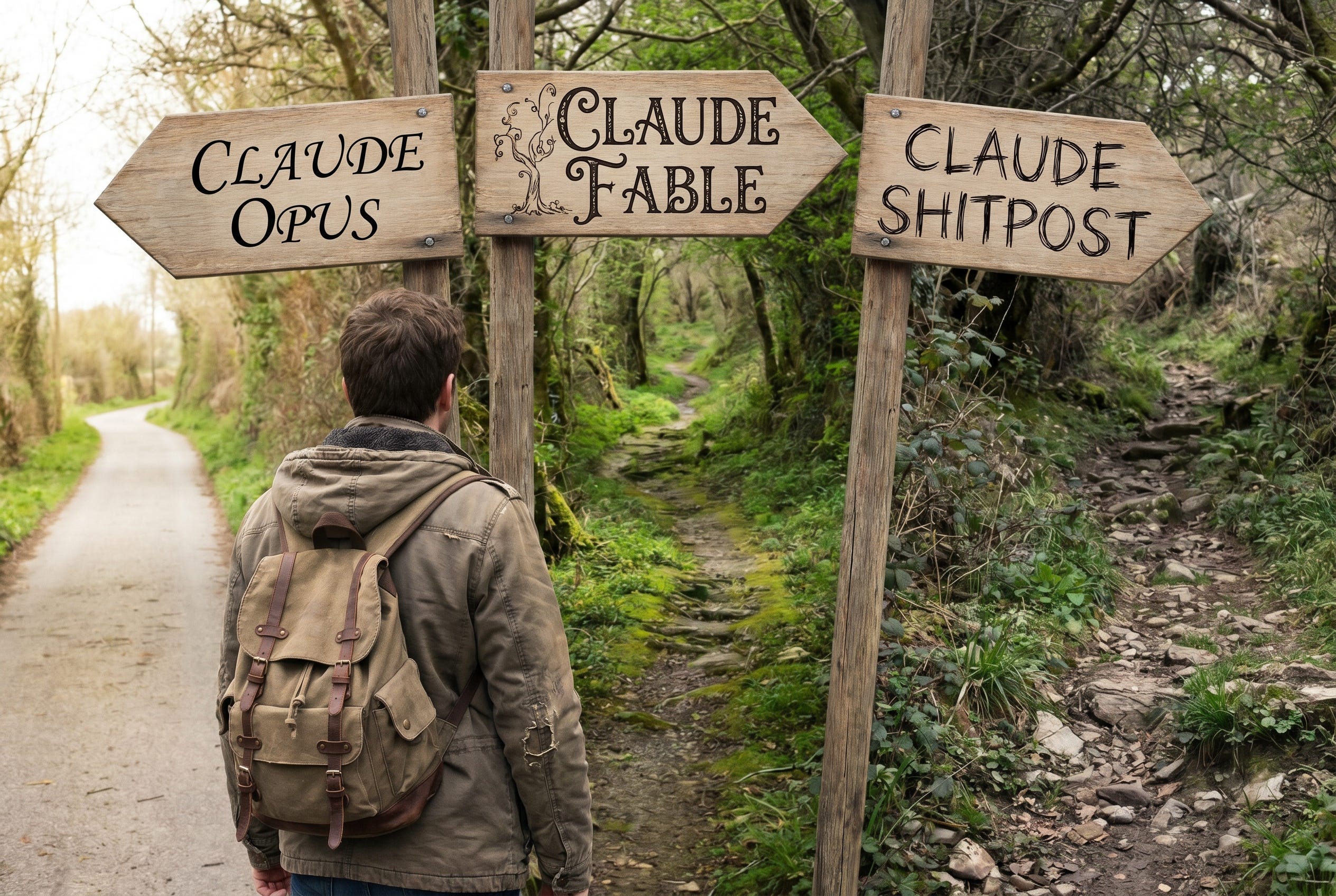
It figures; I whack “Send” and a new model drops. Let’s see here...
In April, Anthropic told the world that Mythos was too dangerous to release. It was so scary! But it’s great. But it’s scary! The fear-based marketing spiel was... a bit much. They built a government consortium around keeping it in a vault, handed it to a hundred and fifty cyberdefenders under the codename Project Glasswing, and said they had no plans to ship it to the public. The model was so good at finding software vulnerabilities that letting strangers use it got framed as a national-security question.
And then two months later they shipped it to anyone with a Pro subscription.
The thing they shipped is called Fable 5, following their naming convention of “types of writing.” One day I look forward to seeing them release Claude Shitpost, but that day is not today. Fable is the same underlying model as Mythos with a layer of classifiers bolted on top that watch what you ask and, roughly one session in twenty, decide you can’t have the good model and route your question to the previous one instead. So the most capable model Anthropic has ever made generally available also ships with an asterisk that occasionally hands you the model it replaces. Let’s talk about the asterisk, because it’s where all the interesting economics live.
The price is Opus, in a hurry
Fable 5 is out today on the API and every paid tier at $10 per million input tokens and $50 per million output. That’s exactly double Opus 4.8’s $5 and $25. It is also, to the dollar, the price of Opus 4.8 in Fast Mode. So the new frontier model costs precisely what the old frontier model costs when you ask it to type faster.
The capability claims are the usual launch buffet, and some of them are even real. Stripe says it compressed months of engineering into days on a fifty-million-line Ruby codebase, which is the kind of specific, customer-attributed claim worth more than ten benchmark charts. It also beat Pokémon FireRed using only screenshots, which is delightful and tells you approximately nothing about your bill.
The classifiers route you to Opus 4.8, and they tell you
Here’s the part to understand before you wire it into anything. Fable ships with classifiers covering three buckets: cybersecurity, biology and chemistry, and distillation, which is their word for people trying to clone the model’s capabilities to train a competitor. Trip one and the response comes from Opus 4.8 instead, with a note telling you it happened.
Anthropic says this fires in under 5% of sessions and that a fallback beats a refusal, which is true. But analyze the economics for a second. You’re paying Fable’s price, $10 and $50. When the classifier fires you get an Opus 4.8 answer, the same Opus you could have bought directly for $5 and $25. So one session in twenty, the safety system’s net effect is to charge you double for the cheaper model, presumably while you watch the little note explain why. The biology and chemistry net is currently cast wide enough that most requests in those areas fall back, so if your work touches a beaker you’re paying frontier rates for the floor below frontier a good deal more than one time in twenty.
This isn’t me objecting to the safeguards. The uplift case for a model that finds zero-days across every major OS is a concern and they’re right to be nervous about it. Rather, it’s an observation about who’s holding the meter when the safeguard does its job, because it feels somehow wrong to refuse to do something but take someone’s money for it anyway.
Thirty-day retention, now mandatory
Anthropic is also requiring 30-day data retention on all Mythos-class traffic, business customers included, across first- and third-party surfaces. They won’t train on it, they’re logging human access to it, they delete it after the window in almost all cases, and we can probably pretend this isn’t happening, right? The stated purpose is catching multi-request attacks and reducing false positives, which is plausible.
It’s also a thing that, until today, your enterprise data agreement may have promised you didn’t have to do. If you’re the person who negotiated zero-retention into a contract so you could put a frontier model in front of regulated workloads, “mandatory 30-day retention on the new model tier” is a sentence you want to read before, rather than after, the migration. Enterprise legal departments will almost certainly scream about this before inevitably signing the contract anyway.
The subscription that comes and goes
Now the part that reads like a hostage note with somehow worse legibility.
Fable 5 is included on Pro, Max, Team, and seat-based Enterprise plans through June 22. On June 23 it comes off those plans, and using it requires usage credits. After that, “when sufficient capacity allows,” they aim to put it back into the subscriptions. They’ll extend the included window if capacity allows, and restore standard access as quickly as they can.
Read in order, the offer is: it’s free, then it costs money, then it’s free again, terms and dates subject to how the GPUs are feeling. This is a thirteen-day trial that they’re calling a launch, attached to a model they’re describing as the most capable they’ve ever released. The honest version of the sentence is “we don’t have enough compute to give everyone this model, so we’re going to give it to everyone for two weeks and then take it back,” and to their credit the announcement nearly says exactly that, in the register of a company that would prefer you focus on the giving rather than the taking-back. It pointedly does not address how, if capacity is so dear, they’re able to give it to everyone for those two weeks at launch, when interest and thus demand is clearly spiking.
I read the rollout schedule three times to make sure I had the sequence right. I believe that I did. It’s in, then out, then in, and the only firm date in the whole arrangement is the one where it leaves.
It’s that “demand is hard to predict” and “capacity allows” are included in a launch announcement for a flagship model, which is the AI-industry version of a restaurant putting its best dish on the menu with a footnote reading “if we feel like it.”
So if you’re putting Fable into production, do the boring thing before June 23: figure out which of your workloads trip the classifiers, because those are the ones where you’re paying double for Opus 4.8, and price your fallback path at the model you actually get rather than the one on the label. The capability is, as per early reports, real. The asterisks are painfully real. Plan accordingly.
do you think we cant tell that this is AI generated? very disappointing, thanks for wasting my time.
" model was so good at finding software vulnerabilities..."
Um, not really, not better than other models. What it IS good at is writing exploits for them. Frighteningly, oh shit good.