
No failover for the Commerce Secretary
The US government switched off Anthropic's two best models for every customer on Friday evening. Your disaster-recovery plan has a runbook for an outage, yet nothing for a letter from Commerce.

The problem with writing this newsletter is that very often the things that are true when I start writing are no longer true an hour or so later, when I’ve finished writing. Let’s see if I can get this out early, in-flight to the AWS Summit in NY, before the situation changes. If events once again outpace me, it’s imperative that you not email me about it. Let’s race the clock:
I’ve spent many years telling folks that various things (this week’s: AI dependency) distills down to a vendor-risk problem, with knowable failure modes: prices go up, rate limits get chokingly tight, the version or model you’ve standardized on gets Googled, the green of the status page becomes a comforting lie, etc. There are playbooks for all of these, and you can pay your way free of most of them.
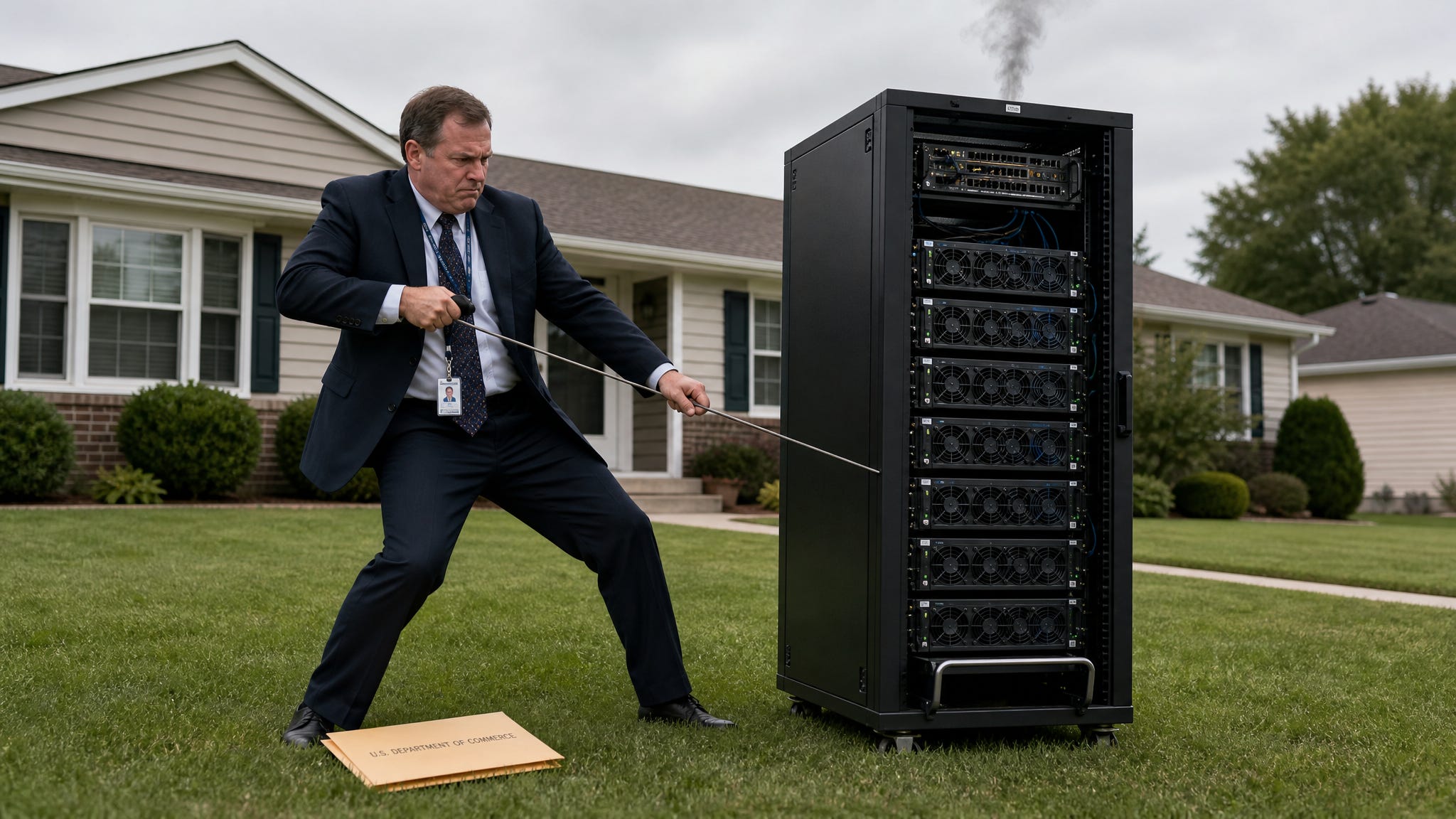
On Friday evening we saw a fifth failure mode show up and the playbooks were either lacking or non-existent. The US government, or the closest thing we’ve got in this era, told Anthropic to take its two best models away from foreign nationals, Anthropic (rightly) determined it couldn’t do that selectively without risking jail time for its execs, and so it took them away from everyone. If you were building on Fable 5 at 5:20pm you were not building on Fable at 6:05pm, much to your surprise. There wasn’t a migration window, no announced timeline, just the equivalent “how quickly can we rip the power cord out the back of these GPU rigs like we’re ripstarting some very expensive lawnmowers.”
So this week, the theme is “learning the thing you rent can not just be repriced, but can also in fact be repossessed.”
What Actually Changed (Adjusted For Spin)
Anthropic’s best models went dark by federal letter
Anthropic released Fable 5 and Mythos 5 on June 9, with Fable pitched as the first time the company put a model of that tier in front of the general public. The Commerce Department, in a directive signed by Secretary Lutnick, had some thoughts the next evening at 5:21pm ET, of the form “now you listen here.” It cited national security authorities and ordered access suspended for any foreign national, whether inside or outside the country, including Anthropic’s own foreign-national employees. Because there is no clean and prison-proof way to wall those people off one model at a time, Anthropic disabled both models for every customer to stay compliant. It’s been reported that this is the first time a leading lab has pulled a deployed model offline because the federal government said so, and I have not found a counterexample. Given the reaction we’re seeing, I kinda think I would have heard if it were otherwise.
The stated reason for this is a jailbreak. As per Anthropic, the demonstrated technique amounts to asking the model to read a codebase and fix the flaws in it, which surfaced a few minor vulnerabilities that other public models find too. That seems less a “jailbreak” than it is “the exact capability they’re using to market the model.” In effect, it seems that “being good at the job” is now a reason your vendor can lose the ability to offer it to you.
Anthropic is complying, because prison, while saying that it believes this to be a misunderstanding, CNN, citing Axios, reports the directive would require a license not just for export but for domestic transfer of the models, which, if this remains true, means moving the weights between two datacenters in the same country is now a paperwork event. Yay, paperwork!
Either way, the practitioner takeaway is not “the government overreached” or “Anthropic was reckless.” Pick whichever of those you like at dinner, fine, whatever, I really don’t care that much about the reason. Because the takeaway is that your disaster-recovery plan has a runbook for us-east-1 falling over due to coup or asteroid strike or whatever, and nothing whatsoever for a one-page letter from Commerce, and no amount of multi-region anything fixes that, because the thing that failed was not the infrastructure unless you believe in the 8th layer of the OSI model (politics).
Meanwhile, three coding tools metered the buffet in two weeks
While the dramatic repossession was getting the headlines and Twitter screaming, a far quieter one has been going on relatively stealthily, and it is the one that will actually move your bill. The flat all-you-can-eat seat for agentic coding is being retired across the category, because an agent that runs autonomously for an hour burns serious compute and the flat fee was subsidizing the heavy users out of the light ones’ pockets, as is always the way with subscriptions.
We’ve talked about GitHub Copilot doing this a couple of weeks ago, but I missed that Windsurf became Devin Desktop on June 2 in an over-the-air update from Cognition, with Cascade, the local agent a lot of CI pipelines call by name, going end-of-life July 1. This wasn’t coordinated, so put your tinfoil hats away; it’s an emergence of what we’re seeing industry wide. What it means is “if you have automation that invokes Cascade, that is a serious deadline with your name splattered on it, and “the editor renamed itself overnight and my pipeline broke” is a sentence you would presumably prefer not to say to your team on July 2.
The honest read is that metered pricing is more correct than flat pricing. A heavy user and a light user genuinely do not cost the vendor the same, and pretending otherwise was always a subsidy with an expiration date. The catch is the one every cloud customer already knows in their soul: “you only pay for what you use” is a wonderful promise right up until an agent decides to use rather a lot of it at three in the morning.
Reliability: A Brief Retrospective
Follow The Money (Or Watch It Follow Itself)
SpaceX went public on June 12 under SPCX, raised about $75 billion in the largest IPO ever recorded, priced at $135, and closed its first day up 19% near $161, which put the whole thing somewhere north of two trillion dollars, brushing against Amazon’s own valuation intraday. This is of course an AI story now, because the future is stupid, but also because in February SpaceX absorbed xAI and folded it into an AI division, and that division reported an operating loss of $6.36 billion last year and burned another $2.47 billion in the first quarter of this one. The market looked at a rocket company carrying an AI furnace and apparently decided it was worth more than all but a handful of companies that have ever existed. This seems fine,
Note: only about 4% of the shares are actually trading; insiders are locked up for six months and Musk holds something like 85% of the voting power. So the two-trillion-dollar number you are reading is the price the world is paying for the 4% it is allowed to touch, multiplied across the 96% it is not, which is both a fine way to generate an enormous headline and a poor way to learn what the company is worth. Morningstar’s discounted-cash-flow model lands around $780 billion, and the difference between that and two trillion is the dollar value of believing the burn turns into something. (I am pointedly not mentioning the formal investigations now open in several jurisdictions over Grok, because nothing about the substance of those is a joke and I am not going to treat it as one.)
One last thing
Go look at your architecture diagram and find the box, or be honest, boxes where the model lives. You have probably already drawn the arrows for what happens when it times out, and maybe even what happens when the price changes. Add the case where it is simply gone on a Friday because someone in Washington sent a letter, decide now whether your business survives that week, and price the answer accordingly. The vendors spent two years teaching us to pay only for what we use. This week we learned “…only for as long as we are allowed to use it.”
See you next week, unless events once again outpace me..
— C